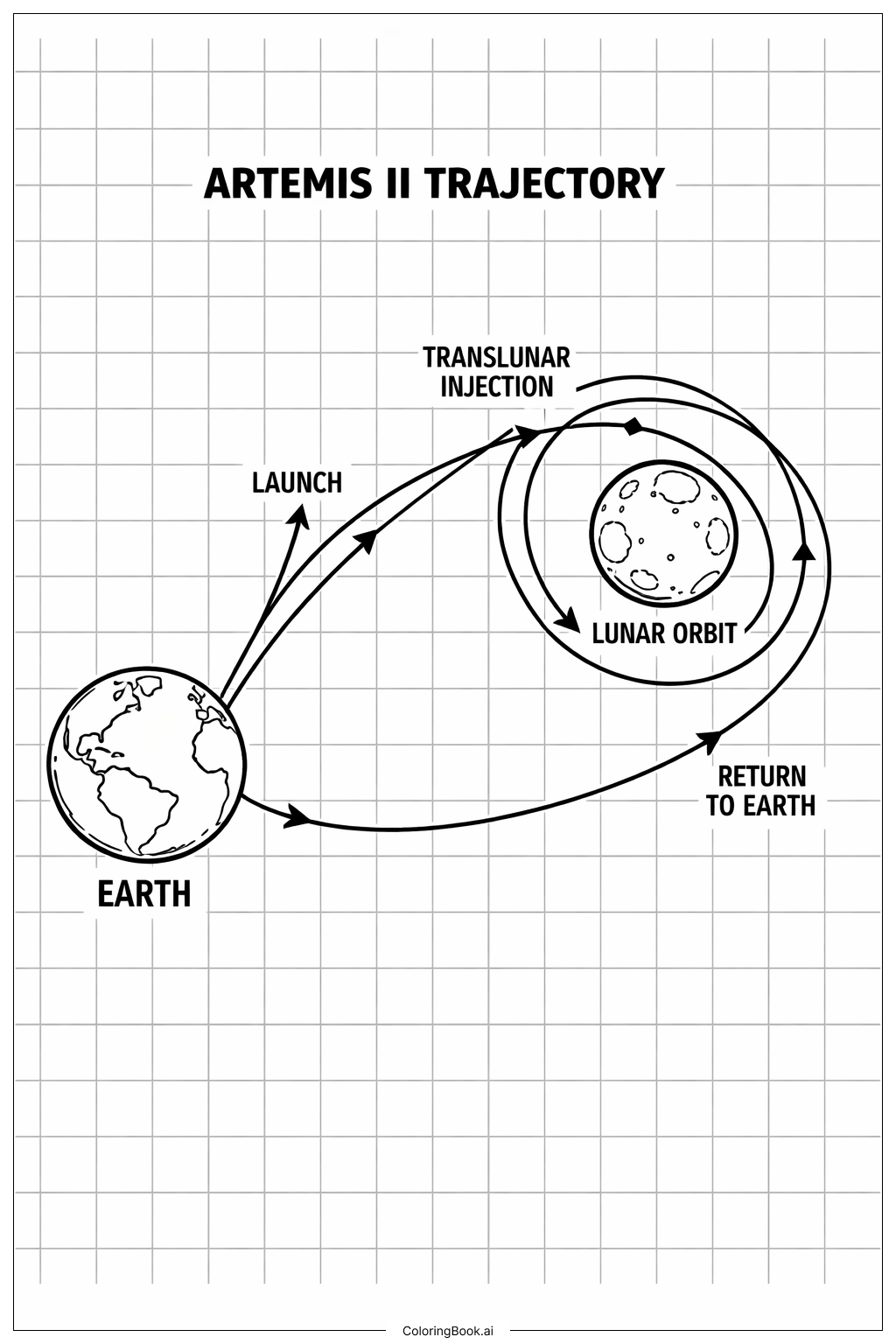
Coloring tips: How to color Artemis II Trajectory Line Map coloring page well?
Try using bright blue and green colors to show Earth with its water and land. The Moon can be colored in shades of gray and white to look rocky and cratered. Use a vivid red or orange color for the Artemis II trajectory line to make it stand out clearly against the dark space background. For space itself, consider using dark blues, purples, or black. You can add touches of yellow or white for stars to make the scene more lively. Keep colors simple and bold to highlight the main parts of the map — Earth, Moon, and the path between them.
Coloring challenges: Which parts are difficult to color and need attention for Artemis II Trajectory Line Map coloring page?
• Thin Trajectory Line: The curved path is thin and winding, so you need steady hands to color it carefully without going outside the lines.
• Small Details: Some mission points along the trajectory are small and require attention to color neatly.
• Contrast Balance: Choosing colors that clearly show the trajectory against space without making the background too messy can be tricky.
• Rounded Shapes: Earth and Moon shapes need careful coloring of smooth curves to look natural and round.
• Space Texture: Creating a realistic space background with stars takes patience to color small dots and keep the area neat.
Benefits of coloring books: Advantages of drawing Artemis II Trajectory Line Map coloring page
Coloring this map helps develop fine motor skills by working on steady hand movements and precision. It also encourages learning about space travel and the Artemis II mission. Engaging with the trajectory line sparks curiosity and improves focus as kids try to follow the path accurately. Using different colors for Earth, Moon, and space enhances creativity and spatial understanding. Lastly, it fosters patience and attention to detail while making a fun, educational artwork.