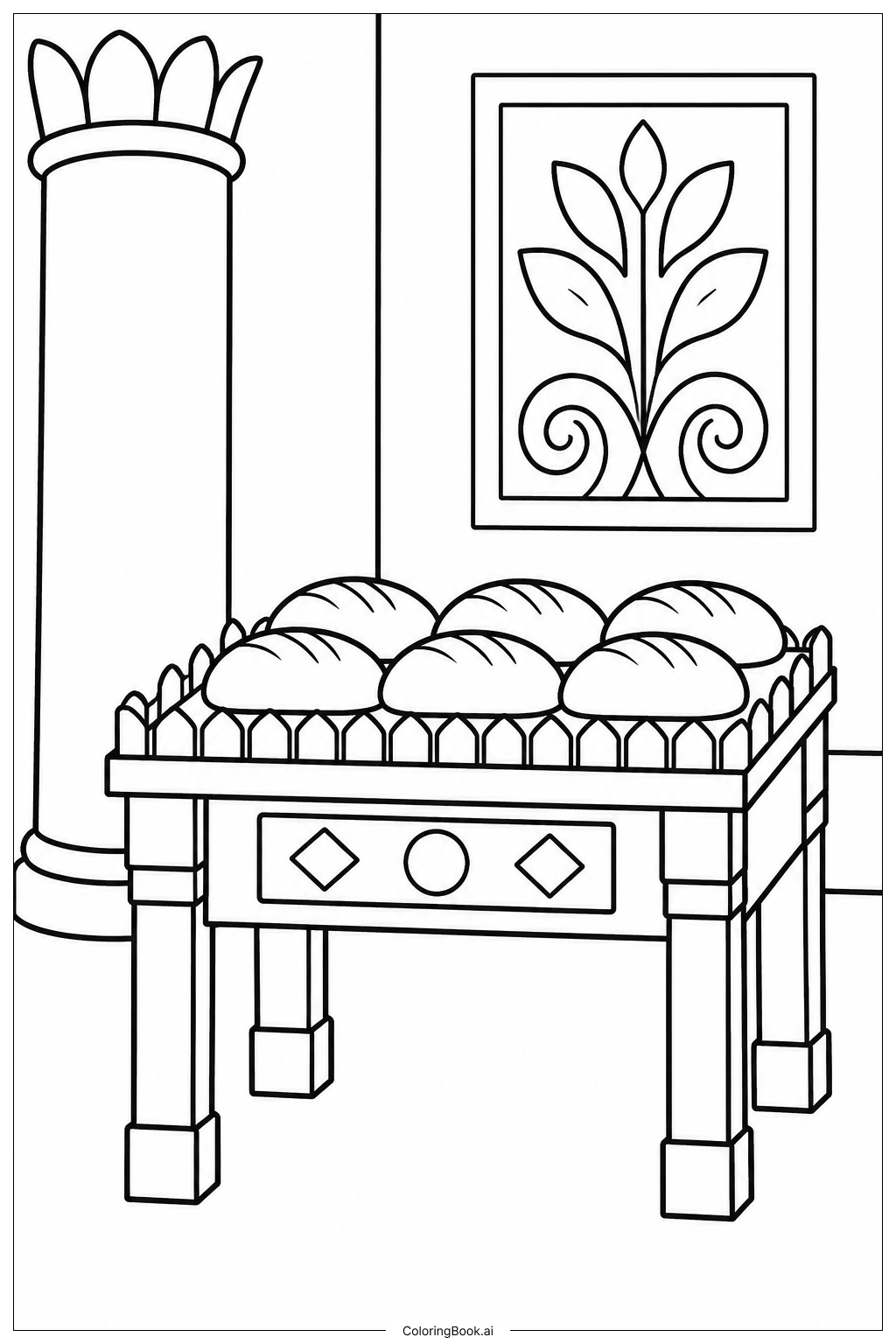
Coloring tips: How to color Table Of Showbread Beis Hamikdash coloring page well?
Start with the table itself. Use bright golden yellow or warm yellow-orange to fill in the gold-covered wood frame, legs, and decorative border. This will make the table look rich and holy, just like real gold.
For the twelve loaves of showbread, use a warm beige or light tan color. You can add a soft golden brown around the edges to make them look freshly baked and realistic.
The carrying rings on the side of the table can be colored in a deeper shade of gold or bronze to make them stand out from the main surface.
If there is any background, try a soft blue or cream tone to represent the inside of the Beis Hamikdash. This keeps the focus on the table without overwhelming the scene.
Take your time filling in the small details like the crown molding along the table edge. Use a slightly darker gold shade there to give it depth and dimension. Younger kids can keep the colors simple, while older children can try blending two shades of gold for a more realistic look.
Coloring challenges: Which parts are difficult to color and need attention for Table Of Showbread Beis Hamikdash coloring page?
• Gold Surface Details: The entire table is covered in layered gold detailing, including the frame, legs, and crown molding around the edges. Staying inside these fine lines requires a steady hand. Using a sharp colored pencil or a fine-tip marker will help you fill each section cleanly without bleeding into neighboring areas. This is one of the trickiest parts of the image because there are many connected golden sections that each need to look distinct.
• Stacked Loaves of Bread: The twelve loaves are stacked in two piles of six, and each loaf has its own outline. Coloring them individually while keeping consistent shading across all twelve loaves takes patience. Try to apply the same base color to all loaves first, then add shading details one at a time so the stacks look balanced and even.
• Crown Molding and Border Details: The decorative border running along the top of the table has intricate repeating details. These small, tight shapes are difficult to color without accidentally mixing colors between sections. Working slowly with a fine-tipped tool makes this much easier.
• Carrying Rings and Side Attachments: The small rings and poles attached to the sides of the table are detailed but compact. They require careful attention to ensure they are colored in a shade that stands out from the main body of the table without looking disconnected from the overall golden theme.
• Depth and Dimension: Because the table is drawn in a three-dimensional perspective, giving it a sense of depth through shading is a challenge. Using a darker shade of gold or brown on the undersides and inner edges will help make the table look solid and three-dimensional rather than flat.
Benefits of coloring books: Advantages of drawing Table Of Showbread Beis Hamikdash coloring page
Coloring the Table of Showbread from the Beis Hamikdash offers a wonderful mix of creative, educational, and spiritual benefits for children and families alike.
Learning through art is one of the most powerful tools for young minds. As children color this image, they naturally become curious about what the table is, why it holds twelve loaves, and what the Beis Hamikdash means. This sparks meaningful conversations about Jewish history and tradition.
The detailed lines and small sections of this image are great for building fine motor skills. Carefully staying within the borders of the crown molding, the bread loaves, and the table legs all help strengthen hand control and pencil grip, which supports writing development in younger children.
Focusing on a detailed image like this also encourages patience and concentration. Kids learn to slow down, plan their colors, and work through a task step by step without rushing.
For older children and Adults, this coloring page serves as a meditative and reflective activity. The sacred nature of the image invites a sense of calm and mindfulness while connecting the colorist to something meaningful and historical.
Sharing this activity as a family creates a special bonding moment, especially around Jewish holidays or learning time. It turns a quiet coloring session into a rich experience filled with questions, stories, and shared creativity.