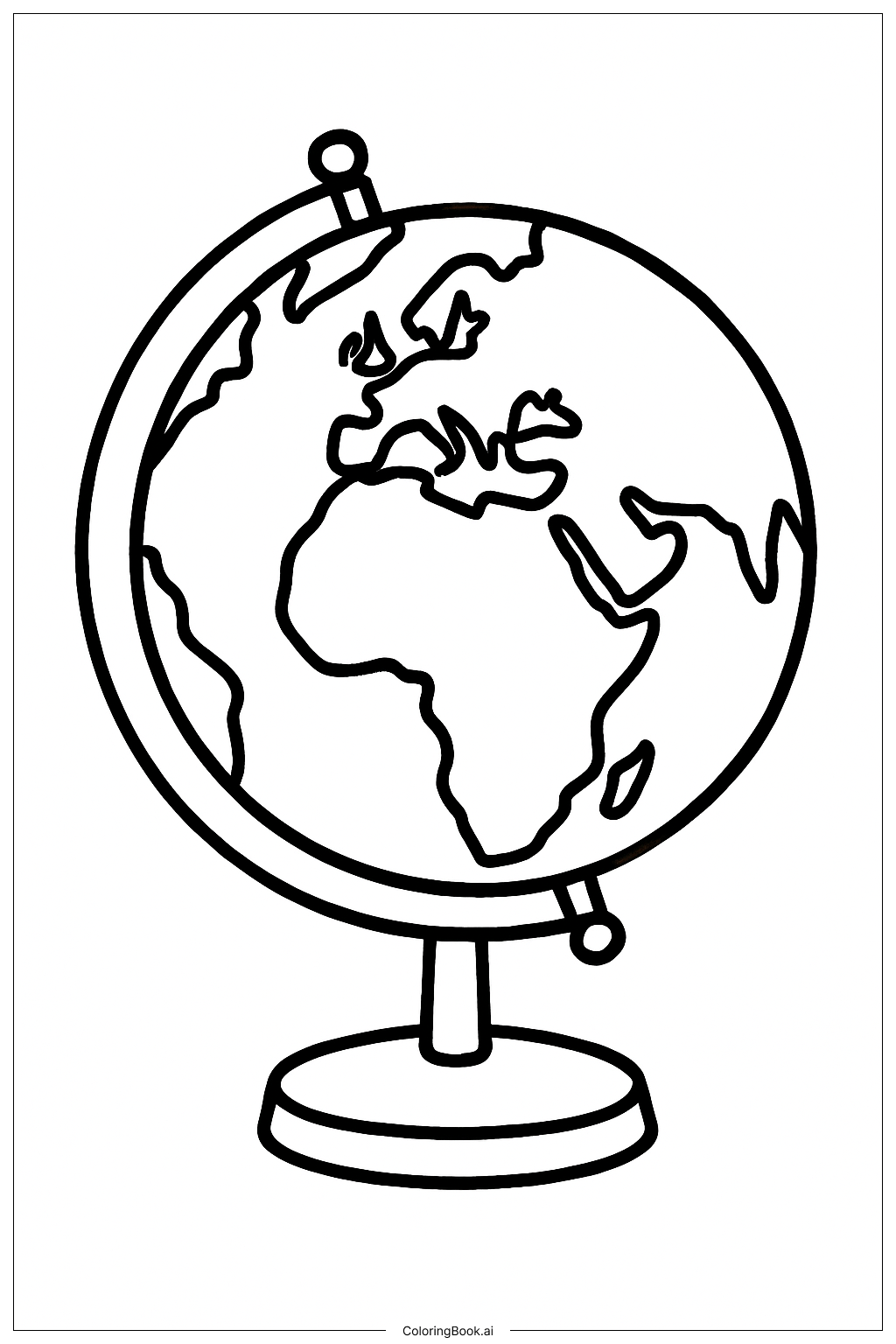
Coloring tips: How to color Science Earth Globe coloring page well?
Start by coloring the oceans in shades of blue — use light blue for shallow coastal areas and deeper blue for open ocean regions. For the continents, choose natural earth tones like green for forests and plains, brown or tan for deserts and mountains, and yellow for grasslands. North America and Europe can be colored with a mix of greens and browns. Africa looks great with warm yellows and oranges for its deserts and rich greens for its rainforests. Use white or light gray for polar ice caps at the top and bottom of the globe. Color the grid lines in a soft gray or light blue so they stand out without overpowering the map. If there is a stand, brown or dark gray works well. Take your time with each continent to make the globe look vibrant and realistic.
Coloring challenges: Which parts are difficult to color and need attention for Science Earth Globe coloring page?
• Continent Borders: The outlines of the continents follow complex, irregular shapes with many curves and jagged coastlines. Staying inside these fine lines requires a steady hand and patience, especially in areas like the coastlines of Europe or Southeast Asia where the edges are particularly detailed and close together.
• Ocean Gradients: Coloring the large ocean areas evenly can be tricky. Achieving a smooth, consistent blue across wide open spaces without streaks or uneven patches takes practice. Using multiple shades of blue to create depth adds beauty but also increases the difficulty for younger colorists.
• Grid Lines: The latitude and longitude lines curve across the globe's surface and intersect at many points. Coloring around these thin lines without accidentally covering them up requires careful attention and a fine-tipped tool. If the grid lines are lost under color, the scientific look of the globe is reduced.
• Small Geographic Details: Some versions of this globe may include small islands, mountain range marks, or country labels. These tiny details are very challenging to color neatly and may require a very sharp pencil or a fine-tipped marker to handle without smudging neighboring areas.
• Rounded Globe Effect: The Earth is a sphere, and giving the flat illustration a sense of roundness and dimension is a creative challenge. Using lighter colors near the center and slightly darker tones toward the edges can create a shading effect that makes the globe look three-dimensional, but this technique requires some experience with shading and blending.
Benefits of coloring books: Advantages of drawing Science Earth Globe coloring page
Coloring this Science Earth Globe page offers many wonderful benefits for children and learners of all ages. As kids fill in the continents and oceans, they naturally begin to learn the shapes and locations of the world's major landmasses and bodies of water. This makes geography fun and memorable in a hands-on way.
The detailed outlines of coastlines and grid lines encourage fine motor skill development. Carefully coloring within small, irregular spaces strengthens hand control and pencil grip, which supports writing skills in young children.
Choosing colors for different regions sparks creativity and introduces early concepts of mapmaking and cartography. Kids can explore what colors represent different environments — blue for water, green for forests, brown for mountains — building connections between art and science.
This page also encourages focus and concentration. Spending time on a detailed image like a globe helps children practice patience and attention to detail, skills that are valuable across all areas of learning.
Finally, completing the globe gives a strong sense of accomplishment. Children feel proud of their finished work, and the colorful globe can serve as a visual reminder of the amazing planet we live on, inspiring curiosity about the world and a love of science and exploration.