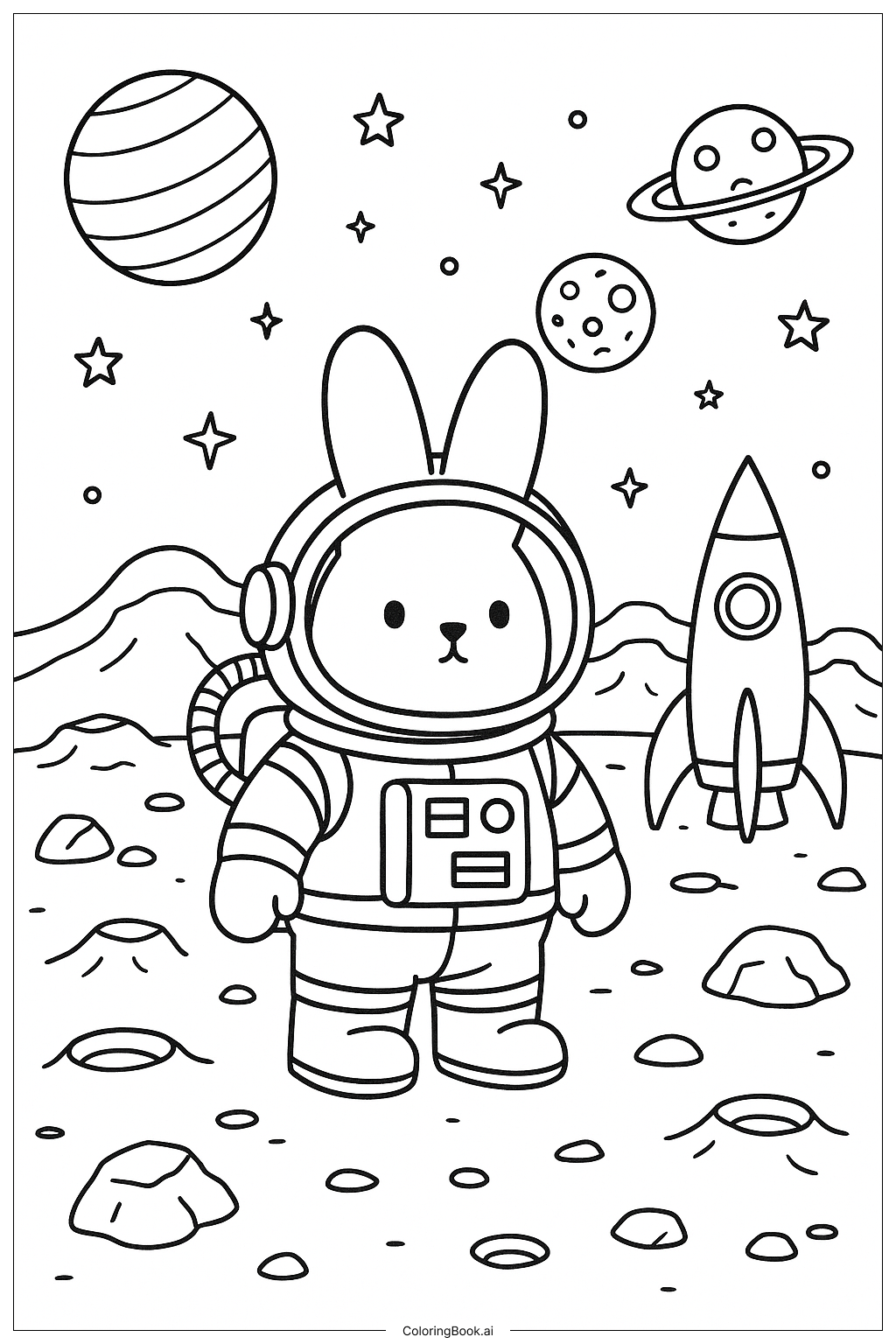
Coloring tips: How to color Peep Space Explorer coloring page well?
Use bright and fun colors for the bunny’s spacesuit, like white or light gray for the suit and bright colors like red, blue, or yellow for the helmet details and buttons. Color the bunny light brown, gray, or any favorite animal color. For the moon surface, use shades of gray and silver, with some darker grays for the craters and rocks. The rocket can be red, white, or blue with colorful details. Use dark blue or black for the space background but add bright colors like yellow, white, or light blue for the stars and planets to make them pop.
Coloring challenges: Which parts are difficult to color and need attention for Peep Space Explorer coloring page?
1. Small details on the bunny’s suit, like buttons and tubes, are tiny and need careful coloring to stay inside the lines.
2. The stars and planets in the sky can be tricky because of their small size and different shapes, requiring patience.
3. Coloring the craters and rocks with shading to make them look round and 3D can be quite challenging.
4. The bunny's face inside the helmet needs neat coloring to keep the helmet glass area clear and avoid mixing colors.
5. The rocket’s slim and pointed parts require steady hands to color smoothly without overlapping the outlines.
Benefits of coloring books: Advantages of drawing Peep Space Explorer coloring page
Coloring this picture helps kids develop fine motor skills by working on small details like the bunny’s suit and stars. It encourages creativity through choosing different colors for space and the characters. It also improves focus and patience because of the many small elements and shapes. Coloring the moon surface and rocks helps children learn about shading and depth. Overall, this picture inspires imagination and teaches kids about space exploration in a fun way.