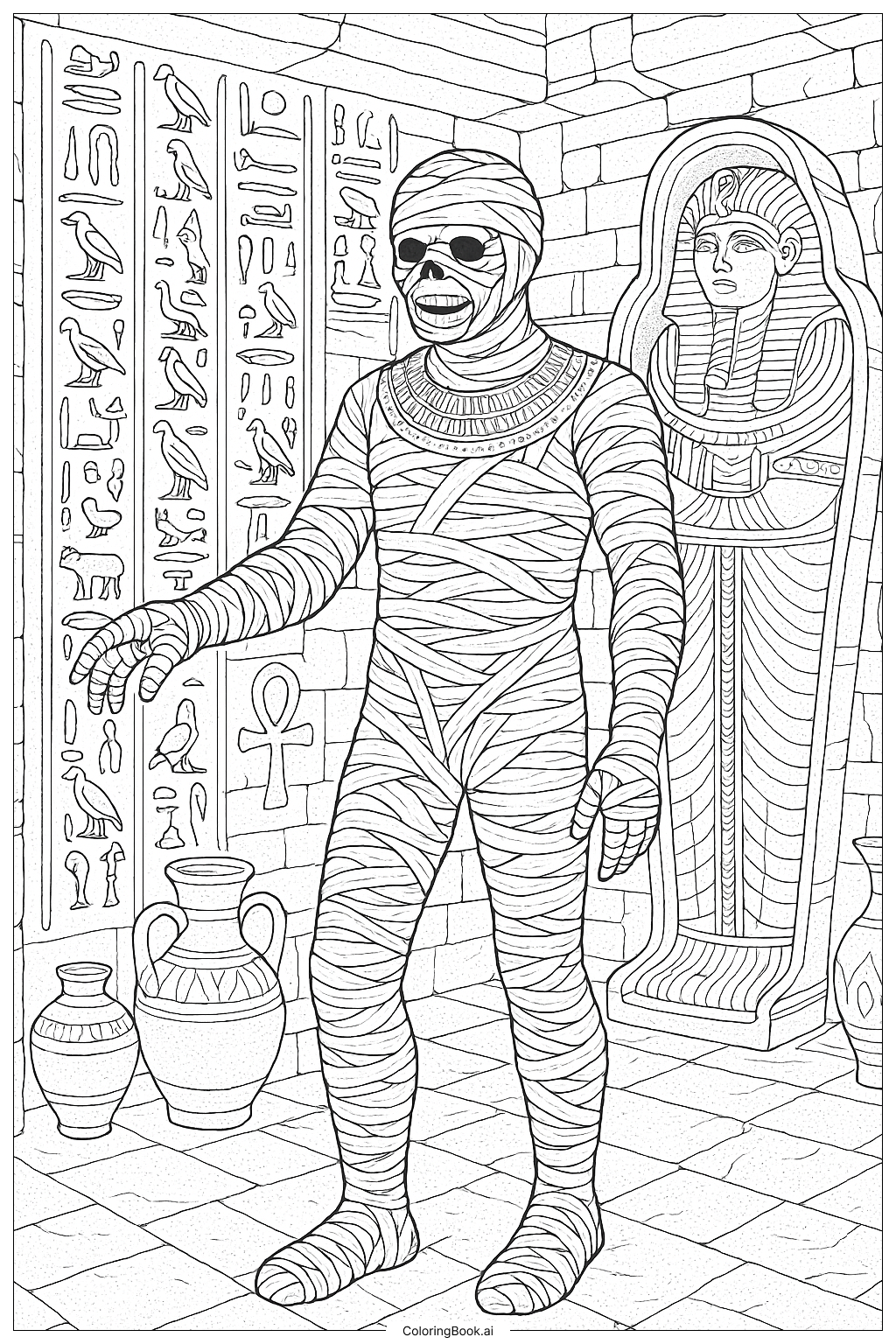
Coloring tips: How to color Mummy In A Room Full Of Hieroglyphics coloring page well?
Use different shades of brown and beige for the mummy's bandages to make it look realistic. Color the collar with bright gold, red, blue, and green to show its richness. For the hieroglyphics, use light yellow or sandy colors on the walls. Paint the pottery jars in natural clay colors like orange, red, and brown. The sarcophagus can be colored with gold and blue, common colors for ancient Egyptian artifacts. Don’t forget to add some shadow effects with darker colors to give depth to the room and mummy’s layers.
Coloring challenges: Which parts are difficult to color and need attention for Mummy In A Room Full Of Hieroglyphics coloring page?
1. Wrapping Detail: The mummy's bandages have many thin lines and overlaps, which can be tricky to color neatly without mixing colors. 2. Hieroglyphics Complexity: The many small symbols on the walls need careful coloring to keep them clear and not messy. 3. Sarcophagus Design: It has many small patterns and lines, needing patience and steady hands to color cleanly. 4. Color Contrast: Choosing colors that stand out well next to the stone walls but still look natural is important to keep the picture balanced. 5. Shading and Depth: Adding shadows to show the 3D look might be difficult for beginners but will make the picture look more real.
Benefits of coloring books: Advantages of drawing Mummy In A Room Full Of Hieroglyphics coloring page
Coloring this picture helps improve fine motor skills as it requires careful coloring inside small spaces like the hieroglyphics and the mummy’s bandages. It also teaches children about ancient Egyptian culture and symbols, making learning fun. Patience and concentration are practiced while filling the detailed parts. Coloring the mummy and the sarcophagus encourages creativity with colors and shading, helping develop artistic skills. Overall, it’s a good combination of history and art that stimulates the mind and imagination.