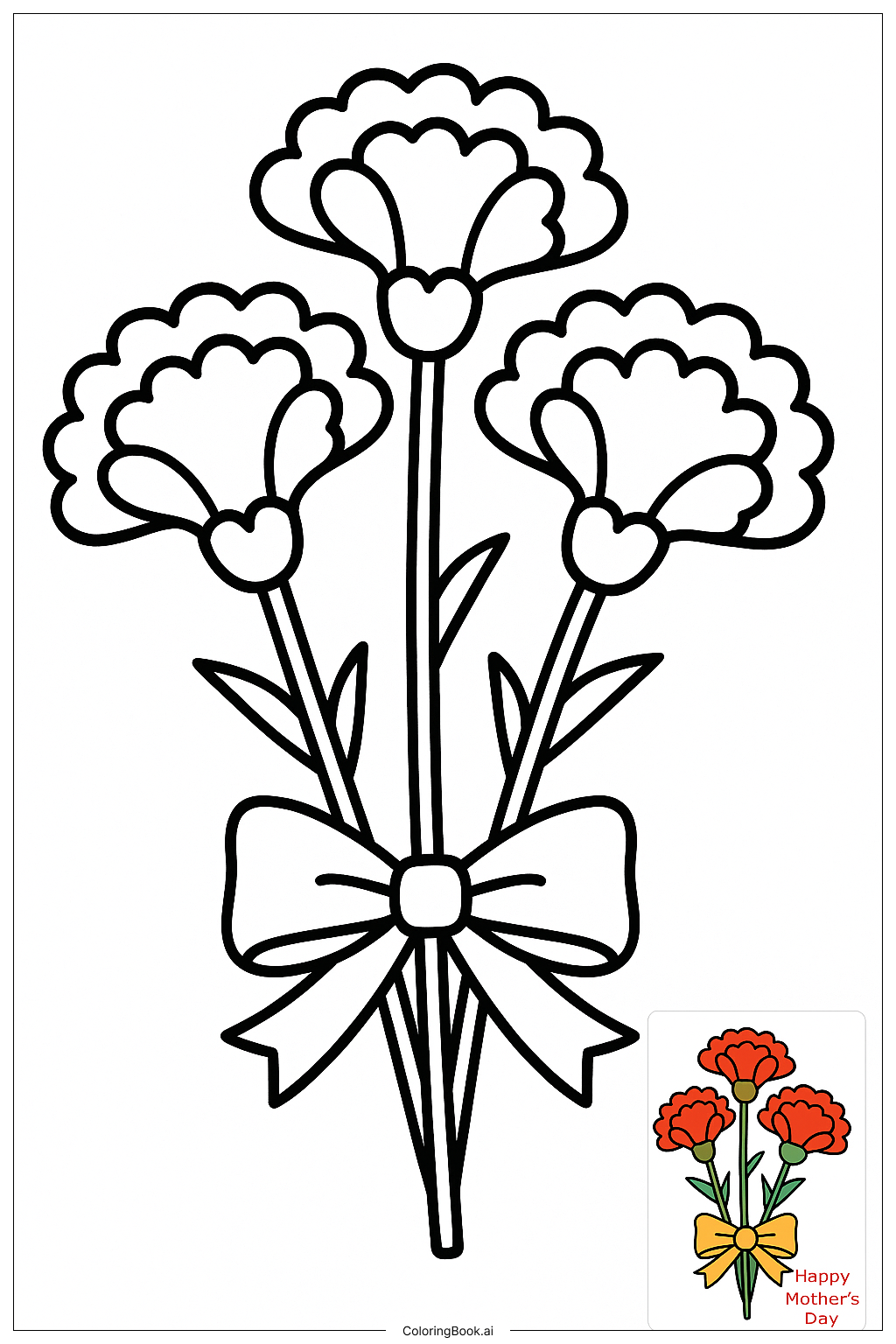
Coloring tips: How to color Mother's Day Carnation Arrangement coloring page well?
Start with the carnation blooms. Pink and red are classic Mother's Day colors, but feel free to try lavender, peach, or white for a softer look. Use a lighter shade in the center of each flower and a deeper shade toward the outer petals to add depth. For the leaves and stems, bright or medium greens work best. Try mixing two shades of green to make the foliage look more natural. Color the ribbon in a cheerful color like yellow, red, or purple to make it pop. If there is a vase or wrapping, soft pastels like light blue or cream keep the focus on the flowers. Take your time with the small petal details — short, gentle strokes help fill the ruffled edges neatly. This is a great image to experiment with blending colors and creating a soft, warm feel that fits the Mother's Day theme.
Coloring challenges: Which parts are difficult to color and need attention for Mother's Day Carnation Arrangement coloring page?
• Layered Petal Complexity: Carnations have many tightly packed, ruffled petals that overlap in multiple layers. Each petal has a slightly different shape and position, making it tricky to decide where one color ends and another begins. Young colorists may find it challenging to shade each petal individually without the image looking flat or muddy.
• Tiny Fringed Edges: The signature fringed or serrated edges of carnation petals are very small and closely spaced. Staying inside these fine lines requires a sharp pencil or a fine-tipped marker. Coloring tools that are too thick will quickly fill in the detail, losing the delicate look of the petals.
• Consistent Color Across Multiple Blooms: The arrangement includes several carnation heads at different angles. Keeping a consistent color palette across all the blooms while still making each one look distinct takes patience and planning. Switching shades too drastically can make the bouquet look unbalanced.
• Leaf and Stem Differentiation: The foliage fills in the spaces between flowers, and many leaves overlap each other. Choosing slightly different green tones for front and back leaves helps create depth, but this technique can be hard for beginners to apply evenly.
• Decorative Accents and Ribbon: Small bows, ribbons, or decorative elements in the arrangement have narrow bands and curves. These areas are easy to color outside of, and getting clean lines around curved ribbon shapes requires steady hands and careful tool control.
Benefits of coloring books: Advantages of drawing Mother's Day Carnation Arrangement coloring page
Coloring this Mother's Day carnation arrangement offers a wonderful range of benefits for kids and beginners alike. Working through the layered petals and detailed stems helps build fine motor skills and strengthens hand-eye coordination. Choosing colors and planning a palette encourages creative thinking and artistic confidence.
Because this image is tied to a meaningful occasion, it also carries an emotional benefit. Completing and gifting this page to a mother or caregiver becomes a heartfelt, personal gesture that teaches children the joy of giving and expressing love through art.
Focusing on the small, intricate details of the flowers promotes concentration and patience. This kind of mindful activity can reduce stress and help kids or adults settle into a calm, relaxed state — a great screen-free wind-down activity.
Learning to blend colors for soft petal gradients builds early color theory skills in a fun, low-pressure way. Kids begin to understand how light and shadow work, and how mixing shades can make flat shapes look full and alive.
Overall, this coloring page combines creativity, emotional expression, and skill-building into one enjoyable activity — making it a perfect project for Mother's Day preparation.