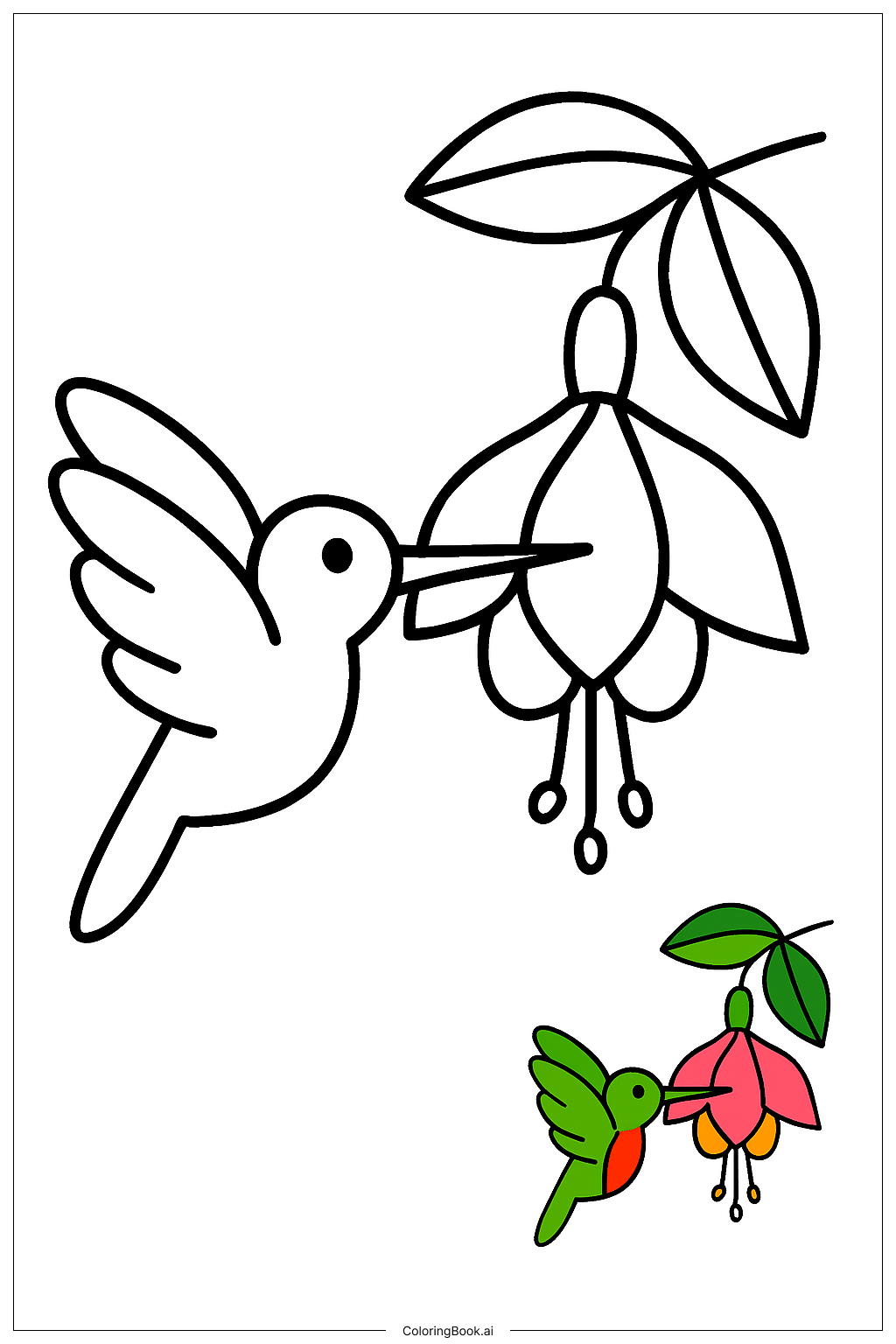
Coloring tips: How to color Hummingbird Hovering Near Fuchsia coloring page well?
Start with the hummingbird's body. Use bright jewel tones like emerald green or ruby red for the feathers, since hummingbirds are known for their dazzling iridescent colors. Leave the throat area for a pop of brilliant magenta or violet. For the wings, try a soft gray or translucent blue to suggest motion and speed.
Move on to the fuchsia flowers. Use two shades of pink or purple for the layered petals. The outer petals can be a deep magenta, while the inner petals work well in soft lavender or pale pink. Color the long stamens a bright white or cream to make them stand out.
For the leaves, choose a rich medium green. Add a slightly darker shade along the edges to give them dimension. A light yellow-green works well for the veins.
Use a soft sky blue or gentle cream for the background to let the hummingbird and flowers truly shine. Keep your strokes light and smooth to capture the delicate feel of this beautiful nature scene.
Coloring challenges: Which parts are difficult to color and need attention for Hummingbird Hovering Near Fuchsia coloring page?
Coloring this image comes with several interesting challenges, especially for younger artists. Here are the key areas to watch:
• Tiny Feather Details: The hummingbird is covered in very small, intricate feather lines. Staying inside these fine lines requires a sharp pencil or a fine-tipped coloring tool. Young children may find it easier to use a single flat color over the whole body, while older artists can try layering colors to mimic the bird's natural iridescence.
• Wing Motion Effect: The wings are drawn to suggest fast movement, with overlapping curved lines. Coloring this area with a gradient, going from darker at the base to lighter at the tips, can capture the sense of speed. Blending two colors smoothly here is tricky and takes patience.
• Two-Toned Fuchsia Petals: Fuchsia flowers have two distinct layers of petals in different colors. Keeping a clean boundary between the inner and outer petals without the colors bleeding together is one of the harder tasks in this image. Using colored pencils and pressing lightly helps control the edges.
• Hanging Stamens: The long thin stamens dangling below the flowers are very narrow. Coloring them cleanly without going outside the lines requires a very fine tool. A thin marker or a well-sharpened pencil tip works best here.
• Layered Leaves and Background: The leaves overlap in several places, making it important to choose slightly different green shades for each layer so they do not blend into one flat shape. Deciding where the background begins and the plant ends also takes careful observation.
Benefits of coloring books: Advantages of drawing Hummingbird Hovering Near Fuchsia coloring page
Coloring this hummingbird and fuchsia page offers a wonderful mix of fun and learning for kids and adults alike.
For younger children, tracing around the bird's body and petals helps build fine motor skills and steady hand control. Choosing colors and filling in each section trains focus and attention to detail in a relaxed and enjoyable way.
For older kids and teens, the intricate feather and petal details provide a satisfying creative challenge. Experimenting with color blending, shading, and gradient effects encourages artistic thinking and boosts confidence.
This image also sparks curiosity about nature. Kids can learn that hummingbirds are real creatures with iridescent feathers that shimmer in sunlight, and that fuchsia flowers are named after their vivid pink-purple color. Coloring becomes a gentle gateway to science and the natural world.
For adults, this page is a calming mindfulness activity. The repetitive, focused motion of coloring reduces stress and helps quiet a busy mind. It encourages creative expression without any pressure.
Overall, this coloring page brings together creativity, nature appreciation, and relaxation. It is a rewarding experience for anyone who picks up a pencil or crayon and gives it a try.